GEO, SEO, AEO, GSO, AIO: The 5 pillars of strategic visibility without advertising on the web.
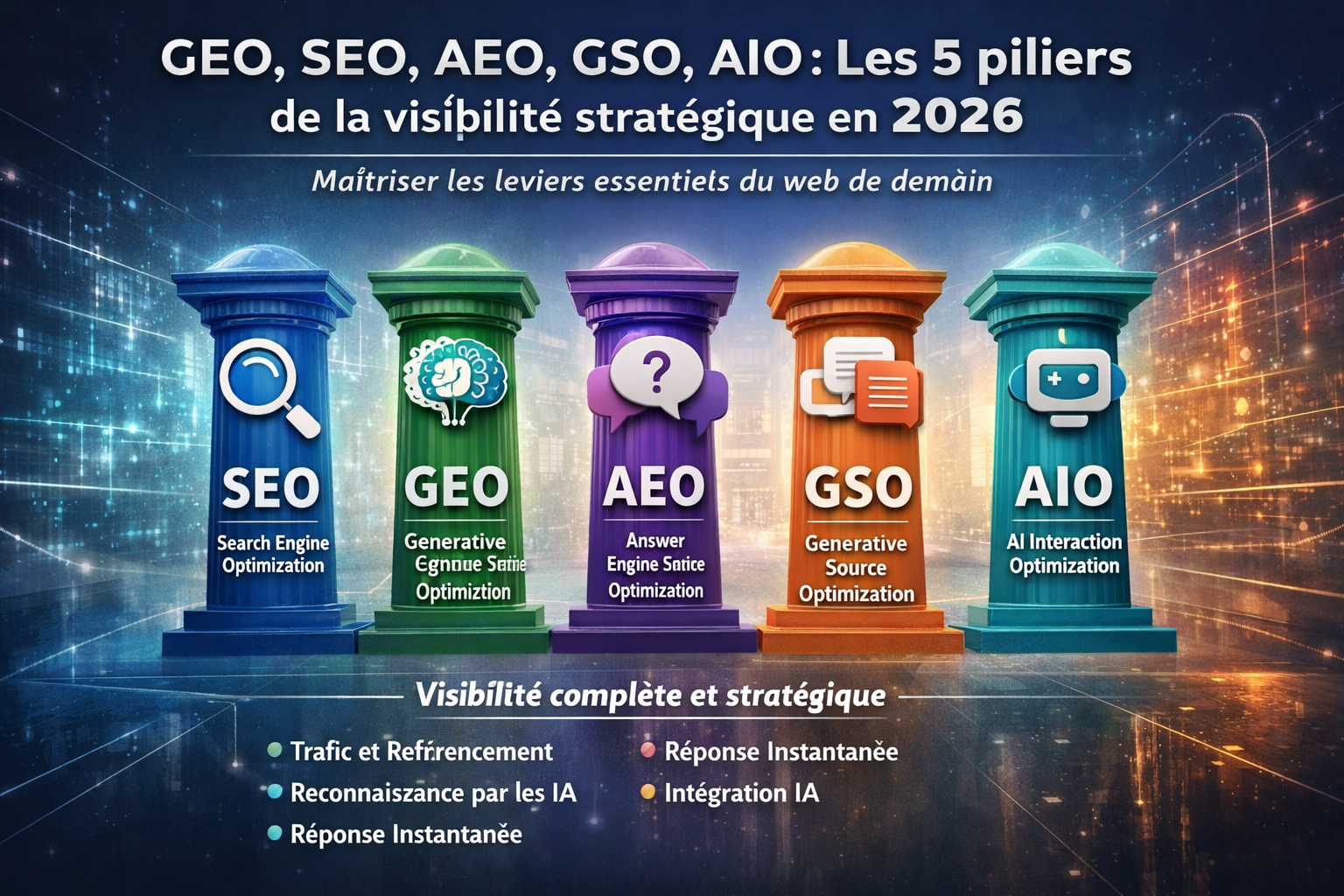
By 2026, the visibility of a company no longer depends solely on Google. It depends on its ability to be recognized, cited and recommended by search engines and General motors (AI). To succeed without going through digital ads like SEA (Search Engine Advertising), you need to master five levers:
- AIO : AI Interaction Optimization
- SEO : Search Engine Optimization
- GEO : Generative Engine Optimization
- AEO : Answer Engine Optimization
- GSO : Generative Source Optimization
The following strategic guide will help you understand, compare and activate these five pillars.
1. SEO: Optimizing for conventional search engines
What is the main objective of the SEO (Search Engine Optimization)) ? Appear in search results of engines like Google, Bing, etc.
Key Steps to Structure the SEO:
- Technical audit: speed, mobile, indexing
- Search for keywords: relevance, volume, intent, competition
- Optimized content: titles, meta tags, depth, originality
- Internal mesh: fluid navigation, coherent links
- Netlinking: quality backlinks
- Monitoring: Google Analytics, Search Console for Google search engine
The SEO will thus generate qualified traffic via traditional engines and ensure a long-term, compound increasing visibility.
SEO limits
On the other hand, since search engines are no longer the only interface for web search, ranking does not guarantee any visibility in IA responses.
2. GEO: Optimizing for Generative Engines (IA)
What is the main objective of GEO (General Engine Optimization) ? Your content is cited, recognized and recommended by AI (ChatGPT, Gemini, Copilot, Perplexity, Mistral AI...).
Key steps to structure GEO
- Monitor IA citations: test the generated responses
- Define its semantic territory: expertise, keywords, niche
- Creating Strategic Content: pillar articles, guides, case studies
- Repeat the authority signals: expertise, coherence, multichannel
- Publish on several platforms: blog, LinkedIn, podcasts, videos
The SEO will generate algorithmic recognition that will influence customer decisions. Also, where the SEO makes you detectable on the net, GEO will make you recommendable.
GEO limits
GEO techniques require more rigour than conventional SEO.
For AIs to quote your content, it must be clear, well structured and accurate.
There is no room for approximations: the generative engines need to solid facts and verifiable, of explicit titles, and coherence strong in the content message. Indeed, an AI only recommends you if she understands what you're saying.
3. The AEO: Optimizing for Response Engines
What is the main objective of the OEA? (Answer Engine Optimization) ? Position your content as the direct response in IA and voice engines (Google SGE, voice assistants).
Key Steps to Structure the OAA
- Identify frequently asked questions in your field of expertise or field of activity: Research intentions
- Create respondent content: FAQ, definitions, short paragraphs
- Structure Content: lists, tables, structured data
- Use schema.org : semantic marking
- Align Semantics: questional keywords, IA-friendly formats
The AEO will thus generate a direct appearance in the IA responses without necessary clicks.
AEO limits
The AEO was created to please conventional search engines, not general AI. In other words: even if your content is perfectly optimized to answer Google's questions, this is not enough to appear in ChatGPT, Perplexity or AI Overview.
These tools use other criteria and sources — AEO alone does not give you access to this universe.
4. GSO: Optimization of the generativ sourcee
What is the main objective of the GSO (Generative Source Optimization) ? Position your content and therefore your expertise as a source for AI to generate answers, synthesises or articles.
Key steps to structure the GSO
- Structure its content with clear facts : names, dates, numbers, testimonies
- Use specific titles, smart lists, FAQs
- Publish on renowned platforms : LinkedIn, sector portal, press specialized in your field of expertise
- Create extractable and citable content
The GSO will allow your content to become the basis of the responses generated by the IA. The GSO demands extreme rigour, as AIs need clear, factual, structured and especially easy to extract content. Content too blurry, too narrative or too marketing can be ignored.
GSO limits
- GSO doesn't guarantee that IA will choose you as your source
Even if your content is perfectly structured, the AI may decide to use other older, more known or more important sites. You optimize to be eligible, without being sure to be used.
- AI do not always quote their sources
Even if your content is used, you may not have direct visibility. GSO improves your influence, but not always your reputation.
- IA models evolve without warning
An update can change how AIs select their sources. What works today may become insufficient tomorrow.
- GSO depends on external platforms
You can optimize your content, but know that you do not control algorithms, models, preferred sources and AI biases.
In summary, GSO is like preparing its content so that an AI can easily copy and paste it. GSO can rightly be seen as a strategy of influence but not a strategy of content control.
5. IOA: SEO increased with AI
What is the main objective of the IOA (Artificial Intelligence Optimization) ? Position your content to be integrated into AI interactions (conversational agents, voice assistants, AI tools) and so your content will generate answers, synthesises or articles.
Key steps to structure the IOA
- Develop micro-contents for use by AI agents
- Create interactive formats: Q&A, simulators, step by step guides
- Using IA-friendly prompts
- Collaborate with open AI platforms : Zapier AI, AI Concept, etc.
The AIO will allow your expert content to become actionable in AI tools used by customers and prospects.
Limits of the IOA
- IAIO depends entirely on IA platforms
Even if your content is perfectly optimized, you do not control the rules of AI assistants, their updates and their interaction formats. You have to adapt to their logic, not the reverse.
- AIs don't "see" all your content
IA agents only use part of what you might publish. If the content is not clear and structured, it will be ignored. AIO requires ready-to-use content.
- AI interactions are still limited
Assistants cannot yet execute all the actions, understand all the nuances and integrate all the formats. Your content must be as simple as possible so that they can integrate.
- The AIO requires a very specific format
AI prefers certain formats such as steps, checklists, Q&A and micro-contents
Avoid the content too long, too narrative or too marketing. It will not be exploited.
- AIO does not guarantee visibility
Content can be optimized, but there is no guarantee that IA will quote it, that IA will integrate it into a response or that IA will recommend it. The AIO increases the chances, but gives no certainty or guarantee.
6. Strategic comparison
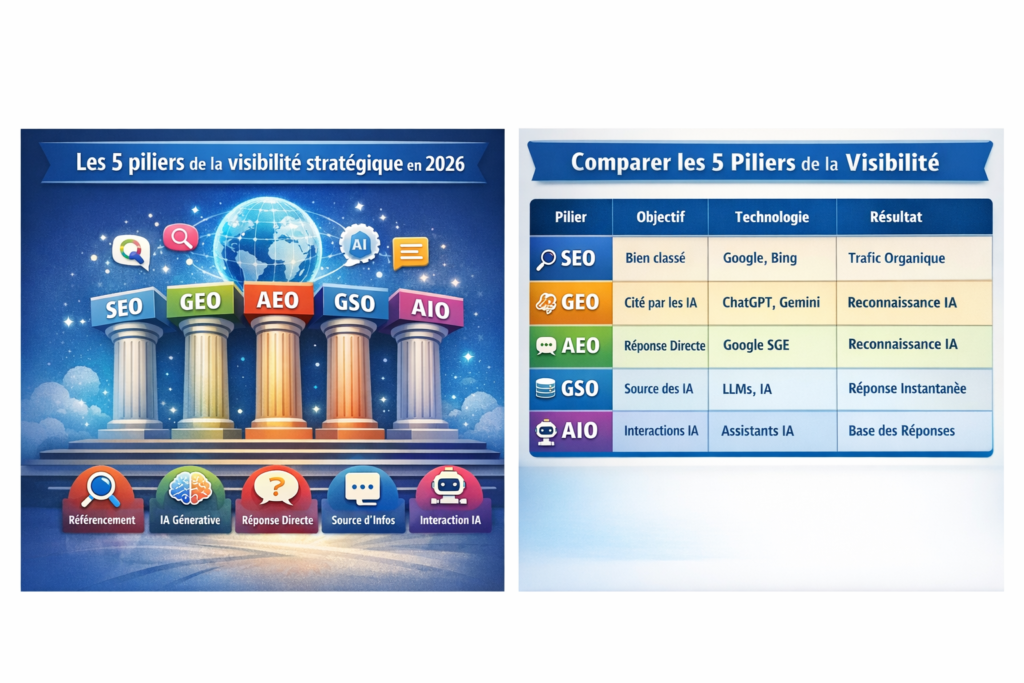
| Pillar | Objective | Goals | Key format | Result |
| SEO | Be well classified | Google, Bing | Optimized content | Organic traffic |
| GEO | To be quoted by AI | ChatGPT, Gemini | Strategic content | Recognition IA |
| AEO | Be the direct answer | Google SGE, Perplexity | Structured content | Instant response |
| GSO | Being the source IA | LLMs, IA engines | Extractable content | Basis of responses IA |
| AIO | Be integrated into AI interactions | IA Officers, Assistants | Interactive content | Presence in AI tools |
7. Conclusion: A 5-level strategy
For full visibility in 2026, an SME must therefore:
- Optimize your site for SEO
- Create strategic content for GEO
- Structure responses for the OEA
- Making its content extractable for GSO
- Create interactive formats for the IOA
These five pillars do not oppose — They complement each other. Together, they allow:
- to attract traffic through traditional search engines
- to be recognized as an expert
- to appear in the responses generated
- to be cited as a reliable and expert source
- be integrated into AI tools
This is exactly what MarketStratix is putting in place for its customers: a comprehensive, sustainable visibility strategy that makes all the difference.