
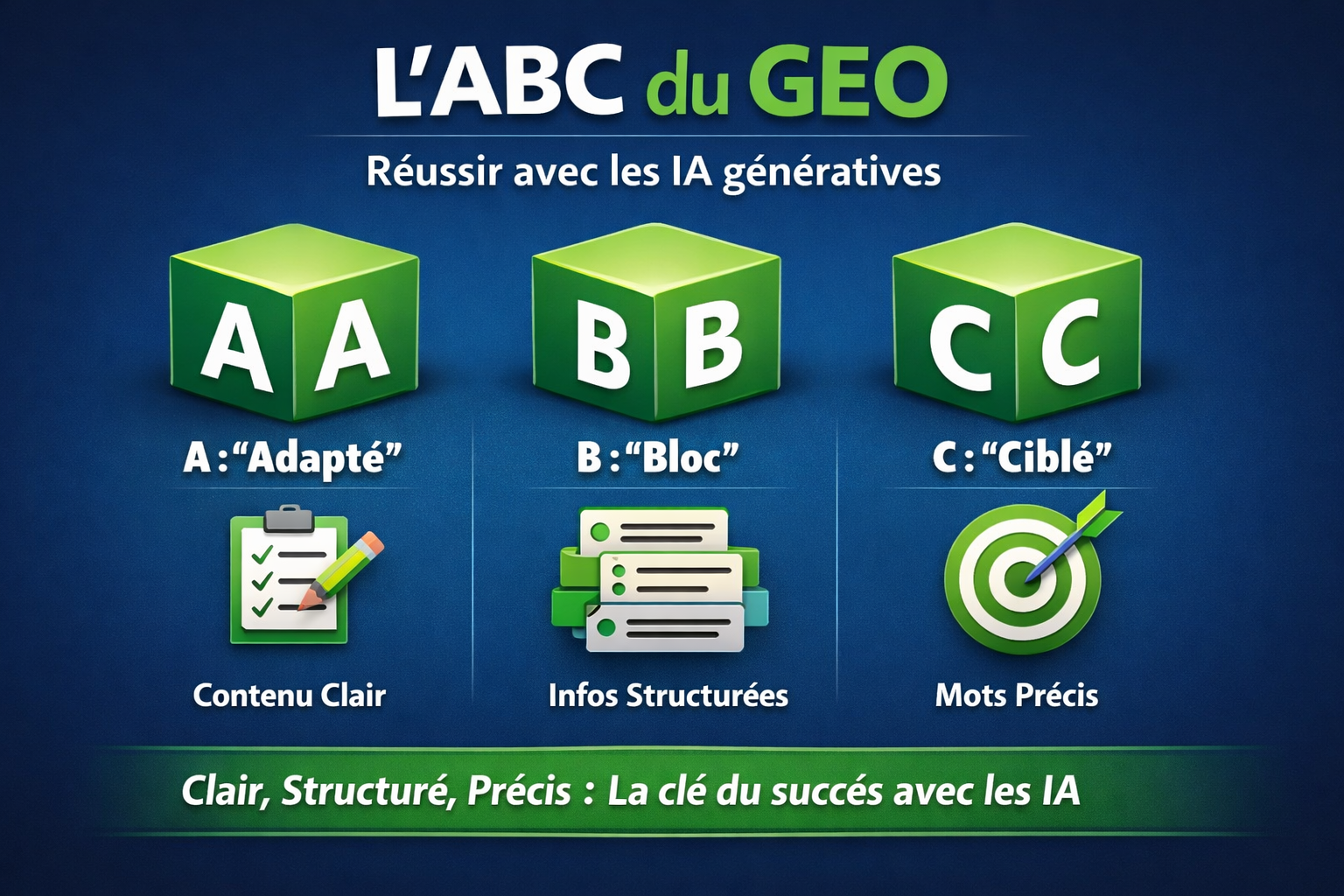
GEO ABC: How to train AIs to recognize you as an expert
The world of online visibility has changed. Search engines are no longer the only custodians of information. Today, General — ChatGPT, Gemini, Copilot, Perplexity — become new intermediaries between companies and their customers.
They don't just offer links anymore. They're responding. They synthesize and above all They have power; they recommend.
And if your business does not appear in their answers, you become invisible. This is where the GEO : Generative Engine Optimization.
1. What is GEO?
GEO aims to optimize your digital presence so that IA generics recognize you as a reliable source. If the AIs recognize you, they quote you, recommend you and use you in their answers.
Unlike SEO, which aims to improve your position in Google,
GEO aims to improve your presence in the generated responses.
In summary:
SEO optimizes for search engines while GEO optimizes for response engines
2. Why did GEO become indispensable?
2.1. Users no longer click
With the arrival of Google SGE and conversational AIs, users get their answers without visiting a website.
2.2. AIs become decision engines
They recommend products, services, companies, experts or solutions. If you are not present in their "memory", you do not exist. Also, GEO is still under-exploited, as very few companies are optimising their website for AIs. It is therefore an opportunity for SMEs who want to stand out without too much expense.
3. The 3 pillars of GEO
Pillar 1 — The Authority
AIs promote sources that are expert (i.e. reliable), consistent, credible and especially well structured.
Also, AIs analyze:
- depth of your content
- consistency of your themes
- the quality of your explanations
- clarity of your definitions
The clearer you are, the more you are quoted.
Pillar 2 — The Semantic Territory
The AIs function by associations of concepts. They must understand your field, your themes, your expertise. For example:
If you are an expert in heat pumps, AIs must associate:
"thermopump", "installation", "maintenance", "energy efficiency", "cost", "grants", etc.
You must occupy your semantic territory.
Pillar 3 — Multichannel Coherence
AIs cross information from:
- your website
- YouTube
- podcasts
- Guest articles
- external publications
The more you are present, the more credible you are. GEO rewards consistency, not quantity.

4. The Steps to Successful GEO
To be effective with its GEO, following these 5 steps:
Step 1 — Define your core expertise
AIs must include in one sentence: "Who are you and how are you expert?"
Step 2 — Create Pillar Content
AIs search the web for complete guides, FAQs, definitions, structured explanations
Step 3 — Repeat Authority Signals
AIs seek and analyze case studies, testimonies, expert articles and in-depth analyses
Step 4 — Publish on multiple platforms
I.A. scans everything. Then the more visible you are, the more you are taken up.
Step 5 — Test Your IA Quotes
Type in ChatGPT or Perplexity for example these simple questions:
- "Who are the experts in » your domain or expertise » ?"
- "What are the best companies for « your service »]?"
And if you don't show up, you have to keep optimizing.
5. GEO vs SEO: two complementary strategies
| Criteria | SEO | GEO |
| Objective | Traffic | Recognition IA |
| Format | Optimized content | Strategic content |
| Target | General | |
| Result | Visits | Quotes |
In summary, SEO attracts and GEO influences. GEO is not a fashion.
It is the new foundation of digital visibility on AI.
The companies that adopt now will be the most credible, the most cited, the most recommended and the most visible by extension.
Do you want to appear in the responses generated by AI?
MarketStratix builds your IA authority footprint.