How to create an automated acquisition system (without costly tools)
Marketing should not depend on chance. Most companies still live at the pace of "pics" and "cry" :
- a month with many prospects
- a month with almost nothing
- campaigns that work once, then never again
- missed follow-up
- lost opportunities
This is not a problem of talent, nor a problem of motivation, but a problem of system. In 2026, the fastest growing companies were those that set up a Automated acquisition system, capable of:
- Capture and Qualify Prospects
- automatically follow them to convert them
- if necessary one or more times if necessary
- analyze their behavior to better adjust
What about the good news? You no longer need expensive tools to get there based on the size of the business. There are multiple alternative varieties on the net.
1. What is an automated acquisition system?
An automated acquisition system is a set of tools and processes that work together to:
- attract prospects and capture information
- send an automatic email and feed the relationship
- Make an appointment to convert it
- monitoring interactions and analysing results to adapt
In short, this system is a dynamic process that runs on its own.
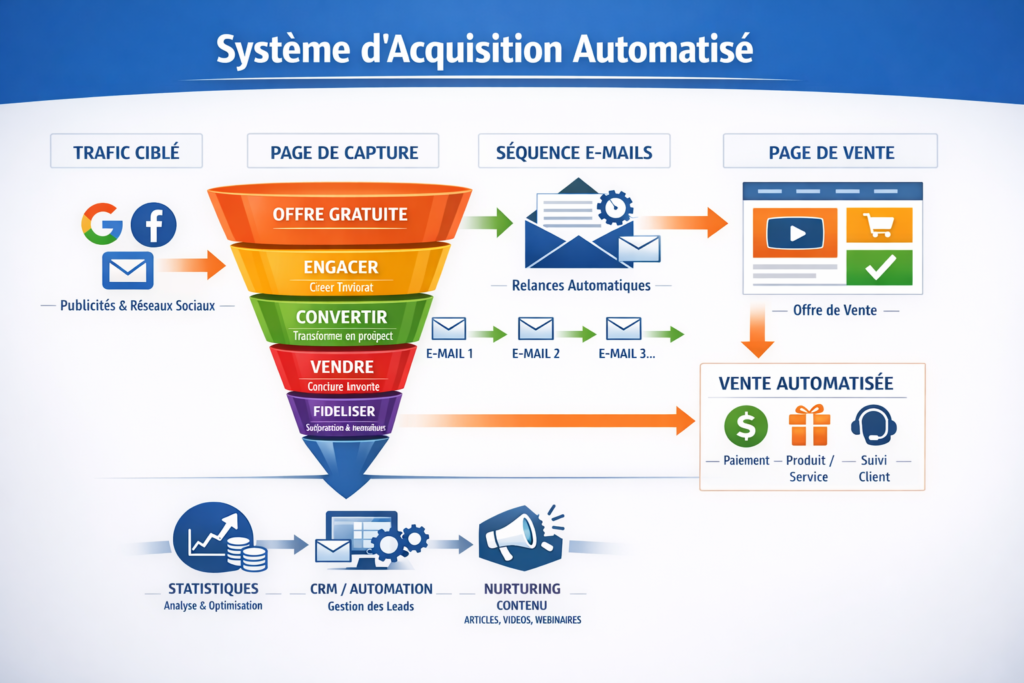
2. The 5 essential components of a modern acquisition system
These are the essential elements of the acquisition system for an SME.
2.1. An optimized website for conversion
A website is not a brochure. It is now the main procurement tool for an SME. It is therefore not to be overlooked.
It shall:
- be mobile-first and quickly load
- clearly explain the supply of products/services
- reassure visitors about its authority, i.e. its brand
- show social evidence, i.e. verifiable customer testimonials
- offer a clear conversion objective (CTA) to get any visitor to act on the site
To do this, the website must bring a visitor's action through a traditional form.
2.2. A smart form
The form must be simple. It must ask only the essential, be fast and trigger an automation to continue the interaction with your visitor. The form is the gateway to your marketing automation system.
2.3. CRM to Centralize Prospects
A CRM whose acronym is Customer Relationship Management (also known as the RCMP for Customer Relationship Management) refers to software focused on customer relationship management. The CRM for the automation system must automatically create contact, apply tags, have categories, trigger an email sequence, track interactions and especially allow targeted campaigns. It's the brain of the system.
2.4. An automated email sequence
A sequence of emails (emails) must meet several requirements including:
- host prospect
- bring value
- responding to the most common objections
- guide to an appointment or online purchase on a store
- create a relationship
The sequence must be programmed to track openings and clicks, send 1 automatic email, see a programming emails 2, 3, 4 via a preset campaign and above all not least be segmented according to different categories of prospects.
2.5. A calendar of appointments
When the company offers services, the prospect must be able to book an appointment without friction. A virtual calendar will therefore:
- automatic appointment making
- automatic reminders to keep your prospect warm
- syncing with your calendar
- reduction of no-shows
This is the last step before conversion.
2.5.Bis Loffer activation
When the company offers products on an online shop, the last step is to offer a activation offer. The prospect may then:
- enter a suggestion basket according to its segment
- triggering an intention to purchase
- plan in its purchase to finally take action
This is a step that is more psychological than technical. The prospect must be able to take action without friction. This step must reduce hesitation and increase the conversion rate.
What the activation offer should contain:
- limited promotion
- an exclusive bonus
- an accessible entry price
- a clear shopping button
- a quick and easy basket
- a secure payment
- a reminder of the value of the product
2.6. Why is this crucial?
Because in an automated system, if there is no request for an appointment, the company loses human commitment.
And without activation, the company loses psychological commitment. In both cases, this step creates a mini-yes if the visitor passes this step before the big yes.
3. How to automate the acquisition system (step by step) for the sale of service
the method of automation of the acquisition system is carried out in 5 major steps like:
Step 1 — Prospect fills out the form
- It captures data
- CRM creates contact
- Tags and categories are applied
Step 2 — Automatic mail delivery 01
Sending the 01 email confirms reception, demonstrates your professionalism and strengthens immediate confidence.
Step 3 — Sequence emails 2, 3, 4 via a predefined campaign
This sequence has for several objectives to achieve such as demonstrating the value of the service and therefore of the company, presenting its social proof, instigating action with an invitation to book an appointment.
Step 4 — Prospect reserves an appointment
A calendar is offered with several free time ranges to choose from and automatic reminders allow to recall the appointment to have less absences.
Step 5 — Behaviour analysis
Then it's good to program a few useful small software such as Heatmaps that records the customer journey and thus allows you to make continuous optimization of your acquisition system.
Conclusion: Automation is no longer a luxury — is a competitive advantage
Companies that automate their acquisition create predictable growth, save time, reduce mistakes, increase conversion and improve professionalism and brand image.
Would you like to build an automated acquisition system for your business?